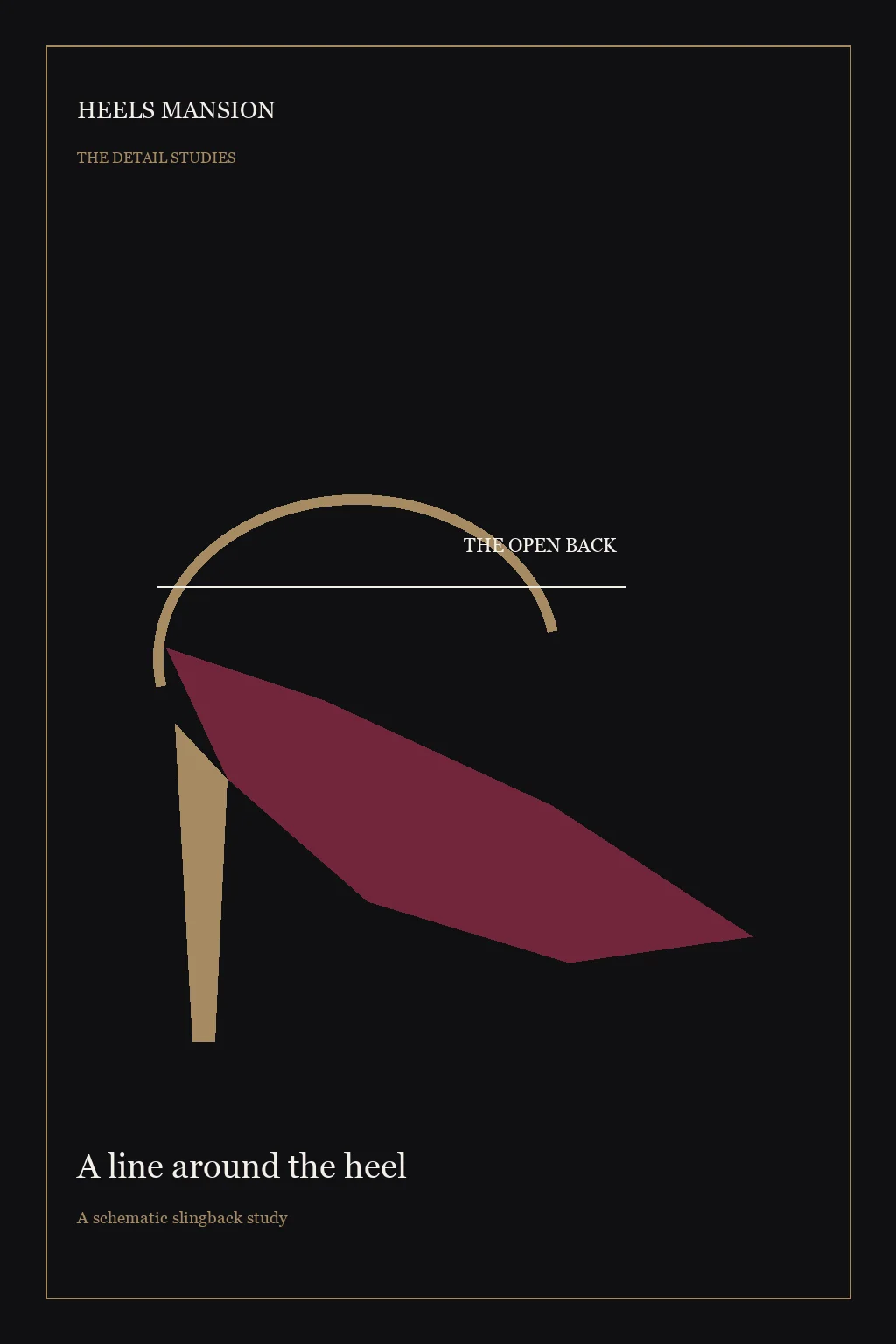
The slingback invites you to look at the back of the shoe. Instead of treating the heel as a closed wall, the design uses a strap and an opening. That small change can make the outline feel quite different from a closed pump. Our drawing is a schematic study of the detail, not a reproduction of a museum object.
Begin with a specific record rather than a sweeping origin story. The Metropolitan Museum of Art lists Steven Arpad’s Model No. 228 as French, dated 1939, in leather and wood. The museum’s description discusses slashed quarters that create a slingback effect. The careful wording matters: a design can suggest an open back without being identical to the slingback you have in mind today.
A second record gives another point of comparison. The Met dates a pair of shoes by the House of Charles Jourdan to 1965 and identifies the materials as leather and plastic, specifically vinyl. Its description connects the colourful slingback shoes with the Pop Art aesthetic of the 1960s. These are two documented objects, not evidence that one designer invented the whole category or that every shoe in a decade followed the same rule.
Open the records and compare what the strap does. Where does it meet the side of the shoe? How much of the back is open? Does the front feel visually connected to the back, or does the strap look like a separate line? The dates make this a historical exercise; the questions keep it useful when looking at a contemporary pair.
For the now, take a shoe you can actually examine. Notice the width and placement of its strap, then compare the heel and toe with the historical objects. Similarity does not prove direct influence. It is simply a starting point for looking more closely. This story is not claiming a current comeback, a sales trend or a designer lineage that the sources do not establish.
When wearing a slingback, include the practical check that a photograph cannot perform. Try the pair, walk in it and pay attention to how that particular strap sits on your foot. The interesting negative space belongs to the design; fit belongs to the person and the specific shoe. Then and now, both deserve a closer look.
Source: The Metropolitan Museum of Art · Steven Arpad · Model No. 228
Source: The Metropolitan Museum of Art · House of Charles Jourdan · Shoes